Brand Guidelines & Styleguide
Brand guidelines are often the last document produced in a brand project, and the first to go stale after handover. The reason is rarely the design team, more often the form: too long, too abstract, too far from daily work. We write manuals that are shorter and last longer. Concretely: less philosophical brand foundation, more applications marketing, product and external vendors can use immediately.
What a useful brand manual contains
A load-bearing styleguide has six parts. First, a short version of the brand strategy with positioning, values and tone on two to four pages. Second, the logo with all variants, clear space, minimum sizes and don't applications. Third, the colour system with primary, secondary and functional colours including HEX, RGB, CMYK and Pantone, plus contrast rules for accessibility. Fourth, typography with hierarchy, size scales, line heights and application examples. Fifth, imagery with photography and illustration direction and the icon system. Sixth, layout principles for print and digital, including templates and commented examples.
Then the often-forgotten part: a governance chapter with versioning rules, approval flows and extension paths. Who may approve new applications, when does the manual get updated, where is the central source. These questions decide whether the guidelines still hold in six months or three unauthorised logo variants are already in circulation.
PDF, website or workspace, which form carries
The classic PDF has its strengths: printable, documentable, linkable in every email signature. It has weaknesses: not searchable, ages fast, hard to update. A digital version as a mini-site or Notion workspace solves the maintenance problem but takes more effort upfront. For most projects we recommend the combination: a printed or PDF master document as reference, a digital version with search and filter for daily use. For smaller brands a well-structured Figma file is often enough.
We deliver brand guidelines not as a closing act but as a starting point. In the onboarding we show the team how to read the system, where the playground sits and when questions are worth asking. What we do not do: glossary brochures with philosophical brand concepts only the communication department understands. A manual is a working tool, not an exhibit.
As short as possible, as clear as needed
We do not write 120-page required reading. A good brand manual is 30 to 60 pages and answers the questions that actually come up in daily work.
Do and don't examples, not just rules
Rules without application are open to interpretation. We show how the logo sits correctly and how it does not, with real applications from the project.
Digital and searchable, not only a PDF
On request we deliver the guidelines as a small website or Notion workspace. So the team finds what it needs in seconds.
Extensible without breaking the system
We define how new applications emerge, who approves them and how versions are documented. So the manual still holds in two years.
Selected work
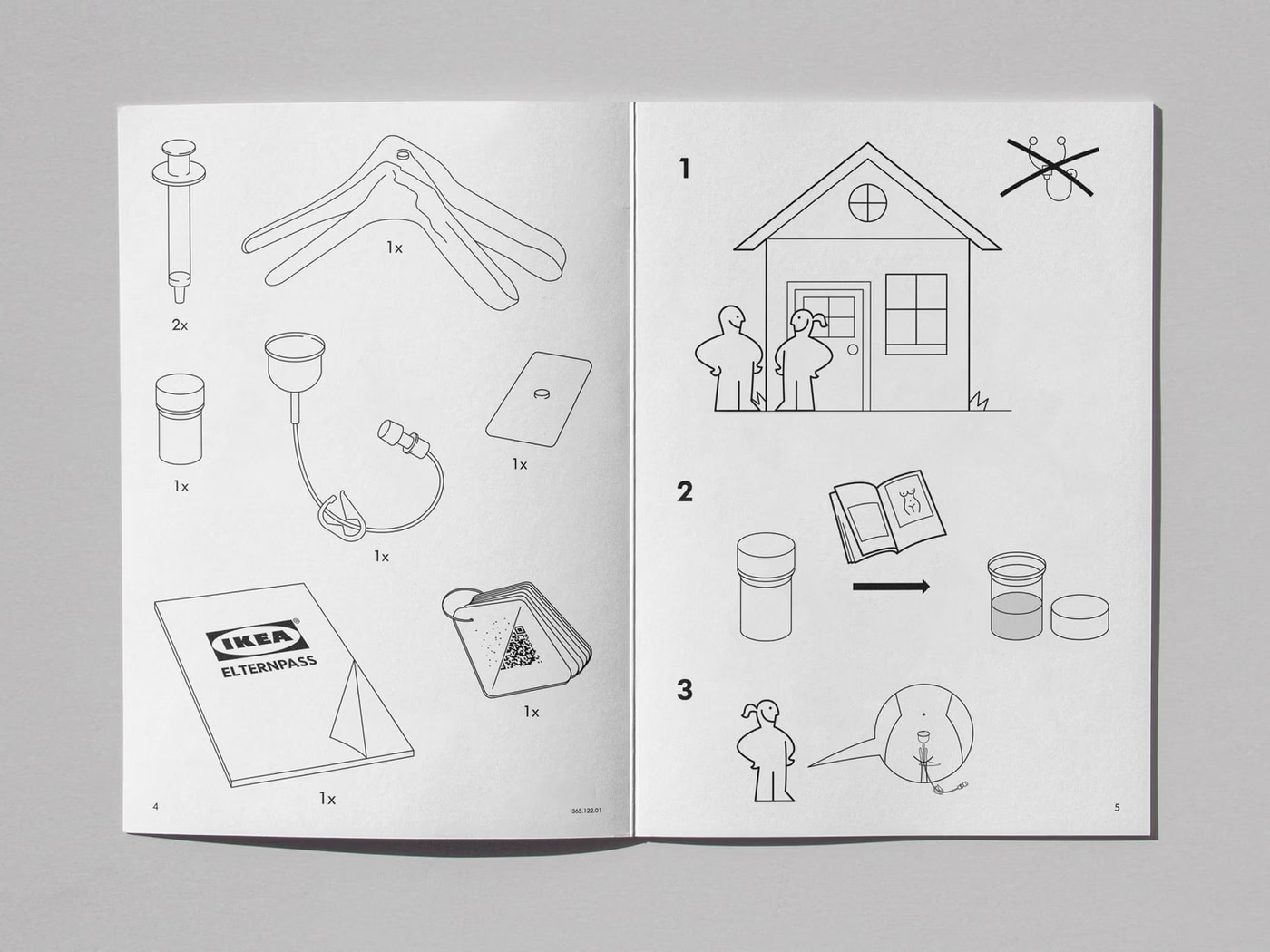
IKEA × AstraZeneca – Concept
Cross-brand concept: how would IKEA package a medical product? A conceptual brand experiment.

Velvet Soul Street – Corporate Design
Streetwear energy in a stitched wordmark: identity, packaging and stationery for a label.

Finanzguru – Brand Design
A fintech brand that works inside a subway tunnel: campaigns, iconography and tone of voice for Finanzguru.
Frequently asked
A 30 to 60 page styleguide with commented applications and shippable templates typically lands between €4,500 and €12,000. An additional digital version as a mini-site costs €2,500 to €6,000 extra depending on scope.
If the visual system is in place, 4 to 8 weeks is realistic. For guidelines built in parallel with a new [visual identity](/en/leistungen/identitaet/visual-identity), creation is part of the larger identity project.
Both make sense. A PDF works for print, onboarding and external vendors, a digital version (mini-site, Notion, Confluence) for everyday team use. For most projects we recommend the combination.
Usually the internal marketing or design team. We set up the maintenance process at handover, document versions and can support annual updates on request. So the manual stays alive.
Yes. Research, reviews and handovers run fully remote. On-site workshops for team onboarding are possible by arrangement, across Germany.
Start a project?
Tell me briefly what it is about — in a 30-minute first conversation we clarify whether and how we can work together.